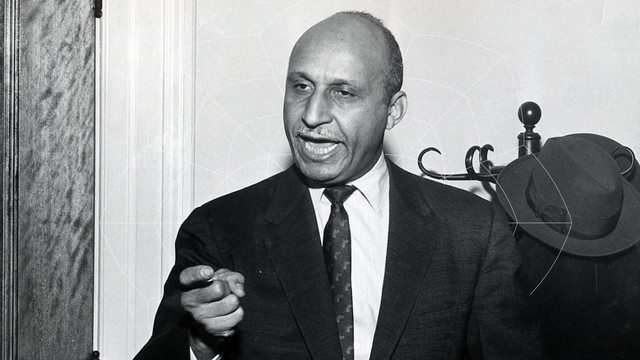
Carrying Forward a Legacy
“No Virginian in the past 100 years has had such an impact on the life of our Commonwealth as Oliver Hill,” former Virginia Governor and U.S. Senator Timothy Kaine once said of the late attorney and civil rights leader. “He moved America from the darkness of the 19th century to the promise of the 21st.”
Despite enduring hostility, cross burnings, and death threats, Oliver Hill remained steadfast in his fight for equal justice. A member of the legal team that took Brown v. Board of Education to the U.S. Supreme Court, Hill also led dozens of other cases challenging unfair housing, discrimination, and segregation. Throughout his career spanning over 60 years, he received more than 90 awards for his commitment to social justice, including the Presidential Medal of Freedom, the nation's highest civilian award.
Now, thanks to a six-figure lead gift from an anonymous donor, Richmond Law will honor Hill’s legacy once more with the creation of an endowed faculty position named in his honor. “Oliver Hill’s life and work embody the very best of what the legal profession can offer society,” said Dean Wendy Perdue. “By establishing this faculty position named in his honor, we recognize his extraordinary legacy and ensure that future generations of lawyers will be inspired by his example of courage, persistence, and service to justice.”
A native of Richmond, Hill came of age during a time when limited educational opportunities were available for African Americans, forcing his family to send him to Washington, D.C. to complete high school. After graduating from the Howard University School of Law in 1933, he returned to Virginia determined to dismantle the Jim Crow era through the courts. His first major Supreme Court victory, Alston v. School Board of Norfolk, secured pay equity for Black and white teachers. Hill went on to challenge segregated schools across Virginia and played a pivotal role in integrating higher education. In 1951, he filed the Prince Edward County suit that became part of Brown, the landmark 1954 decision striking down segregation in public schools.
This fall, Professors Henry L. Chambers, Jr. and Jonathan Stubbs were each named Oliver Hill Faculty Research Scholars.
“Being associated in any way with Oliver Hill and his legacy is an honor,” said Chambers. “He fought tirelessly to help our country move closer to living up to its ideals, and some of the good fortune in my life and the lives of all Americans can be traced directly to Mr. Hill’s work. I remember and honor him by trying to channel some of his intelligence, passion, work ethic, and fearlessness into my work.”
“This position is more than an honorific,” Perdue said. “It is a promise that Mr. Hill’s fight for equality will continue here at Richmond Law through the teaching, research, and scholarship of our faculty. Through this effort, we are committing ourselves — and our students — to advancing the principles of justice and opportunity that Mr. Hill championed.”
The anonymous donor who created the endowed position has committed to adding sufficient funds for it to become a professorship, and invites others inspired by Mr. Hill’s life and legacy to join in contributing to this effort.