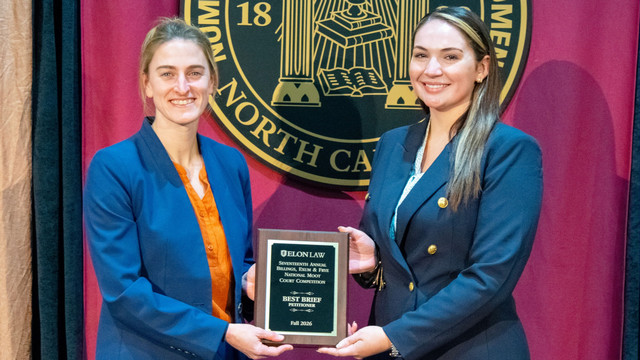
Making the Case: University of Richmond School of Law Students Win National Moot Court Competition
Two Richmnd Law students earned national recognition through their moot court victory over 38 competitors.
November 13, 2026
Do personalized license plates convey the private speech of drivers, and if so, does the First Amendment limit the government’s power to regulate them? Does the Fourth Amendment protect individuals against extended retention of property seized during an arrest?
Students at the University of Richmond School of Law are tackling complex constitutional questions like these—and earning recognition for their advocacy along the way.
Third year law students Lauren Lamp and Rainni Crutchfield recently won the award for Best Brief-Petitioner at the Billings, Exum & Frye National Moot Court Competition at Elon University School of Law. Competing against 38 other teams representing 25 law schools, the pair also advanced to the Round of 16, known as the Octafinals.
“Receiving the Best Brief award was better than winning the entire competition!” Lamp said. “That’s because in the legal field, issues and cases are frequently won or lost on the briefs, and this is especially true in the appellate context where—in the Fourth Circuit for example—only about 12% of all cases are granted oral argument.”
The competition challenged teams to analyze two legal issues that have recently made headlines: (1) whether the State violated the plaintiff’s First Amendment right to free speech when it revoked a customized license plate that used language deemed offensive; and (2) whether using Automatic License Plate Recognition cameras (like Flock cameras) used without a warrant violates the Fourth Amendment’s prohibition against unreasonable searches.
Lamp credits the externships that she has completed at Richmond Law with preparing her for this moment.
“Last spring, I externed with the Hon. Roger Gregory on the Fourth Circuit Court of Appeals, and this semester I am externing with the Virginia Office of the Solicitor General,” she said. “Both of these placements have required me to research complex legal issues, draft strong legal arguments, and succinctly present my conclusions, all skills that I drew upon during the competition.”
A second Richmond Law team, 2Ls Shannon Grow and Jacob Maldonado, competed in the Elon competition and narrowly missed advancing to the Octafinals. Both teams were coached by Cullen Seltzer, L’93 and adjunct professor, whose feedback, advice, and encouragement helped the students prepare.
Experiences like this illustrate the value of moot court competitions as an integral part of legal education. By simulating the work they will do as practicing attorneys, competitions challenge students to move beyond understanding the law to interpreting it, applying it, and advocating for a particular position.
This year’s Carrico Moot Court Competition, organized by the student-led Moot Court Board, offered such an opportunity, asking teams to evaluate a complex case involving police retention of personal electronic devices following an arrest.
Applying case law, weighing policy implications, and developing persuasive arguments on unsettled legal questions, competitors examined whether prolonged property retention violates the Fourth Amendment and whether law enforcement should be required to obtain a warrant to hold on to property indefinitely.
Seventeen students participated in the competition. After submitting briefs on the issue, competitors participated in up to five rounds of oral argument. The competition culminated in a final round ultimately won by 2L Sajith Suraweera. The final round was judged by two Richmond Law alumni, the Hon. Marla Graff Decker, L’83, and the Hon. Jayne Ann Pemberton, L’01, as well as Prof. Jack Preis.
Zealous advocacy is a cornerstone of the legal profession and the Richmond Law mission. Through moot court competitions, both on campus and across the country, Richmond Law students have the opportunity to not only demonstrate their legal knowledge, but also to develop the analytical judgment, communication skills, and confidence necessary to advocate effectively for clients they will represent throughout their careers.